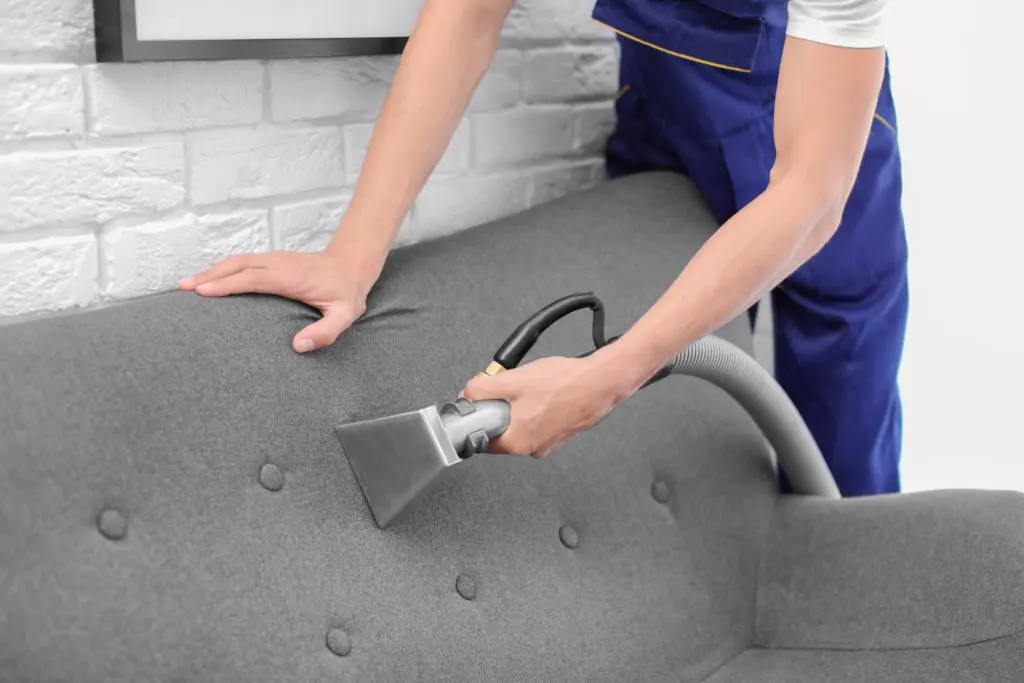
Before anything wet touches a sofa, find the tag and read the letter on it. That single letter decides whether water is the right tool or the thing that will ruin the fabric, and it is the reason two identical-looking couches need completely different treatment.
This guide covers where the tag hides, what each code means, what you can safely do at home for each one, how different fabrics behave, and when to stop. When the answer is that the piece needs somebody with the right equipment, our upholstery cleaning service is where that lives.
The codes, in four lines
- W
- Water-based cleaner is fine
- S
- Solvent only. No water at all
- W/S
- Either. Start with the gentler one
- X
- Vacuum or brush only. Nothing liquid
Finding and reading the cleaning code
The tag is rarely where you expect it. Look under the seat cushions, on the deck they sit on, on a seam under the frame, on the underside of the piece, or on a zipper flap inside a cushion cover. Photograph it while you are down there; you will want it again.
| Code | What it means | What you can do at home | What a cleaner does |
|---|---|---|---|
| No tag | Unknown | Treat it as X until somebody tests it | A fiber and dye test in a hidden spot before anything else |
Know your fabric
Cotton and linen
Natural, absorbent and quick to show a water ring. They shrink if over-wetted, and slow drying can pull brown discoloration up out of the cushion. Minimal moisture, feather the edges, dry fast.
Microfiber and polyester
Hard-wearing and usually coded S or W/S. Some microfibers ring badly with plain water and then clean up with a solvent, which is exactly why the code exists.
Velvet
The problem is the pile, not the soil. Rubbing crushes it permanently. Brush in one direction, blot straight down, never work in circles.
Wool
A protein fiber, so the same rule as wool carpet: mildly acidic to neutral, minimal water, no heat, no scrubbing, and nothing alkaline or bleaching.
Performance fabrics
Often genuinely cleanable with water, sometimes with bleach solutions the maker specifies. Follow the maker document rather than the letter on the tag.
Silk and delicate weaves
Usually coded X, and usually right. Dye movement and water rings on silk are not recoverable.
Everyday care that actually extends the life
- Vacuum the seats and crevices with the upholstery tool, weekly on the pieces you use. Grit works into the weave and cuts the fibers from inside, which is what wears a sofa out long before the soil shows.
- Rotate and flip the cushions so wear moves around instead of building in one seat.
- Keep it out of direct sun. Fading is permanent and no cleaning reverses it.
- Blot spills straight down, the moment they happen, with a white cloth.
- Put a washable throw where the animals sit. Not glamorous, and it beats anything in a bottle.
- Vacuum the fabric after cedar season, which the Texas A&M Forest Service puts between December and January. A housekeeping note about what settles on furniture, and no claim about anybody’s health.
Spot cleaning, by code
-
Test first, every time
A hidden spot: the back of a cushion, under a skirt, the side facing the wall. Apply, blot, and look again once it is dry.
-
Code W
Mild detergent solution on a cloth, not on the fabric. Blot from the outside in, use less liquid than feels right, and feather the damp edge outward so you do not leave a ring. Dry with a fan.
-
Code S
A solvent upholstery cleaner, applied to the cloth, per its label, with the windows open. No water at any stage, including the rinse you are tempted to do.
-
Code W/S
Start with the water-based method. If it does not shift the mark, move to solvent rather than scrubbing harder with water.
-
Code X
Vacuum or a soft brush. That is the whole method. A damp cloth counts as wet.
-
Never soak a cushion
Foam holds water for days while the fabric dries in hours, which is how you get a ring, a smell, or brown discoloration wicking up to the surface.
What a professional cleaning adds
The trade standard is ANSI/IICRC S300, the Standard for Professional Upholstery Cleaning, now in its second edition (2025), which covers fibers and construction, pre-cleaning inspection, methods, leather, spot removal and fabric protectors. We link it as the reference for how the work is meant to be done, not as a credential claim.
Pet hair, odor and accidents
For hair, a rubber glove dragged across the fabric or a window squeegee will pull out more than a vacuum does, because hair is woven into the pile rather than lying on it. Vacuum afterwards to pick up what you have gathered. For an accident on a W or W/S fabric, blot hard, rinse with as little cool water as you can, and use an enzyme cleaner made for pet urine exactly as its label says; the full method is in our pet urine guide. On an S or X fabric, do not attempt it: water is the wrong tool and you will be dealing with a ring as well as a smell. That is a job for Pet Stain & Odor Removal.
How often should upholstery be cleaned?
Other upholstered things in the house
Frequently asked questions
What do W, S, W/S and X mean on upholstery?
W means water-based cleaners are safe. S means solvent only. W/S means either. X means vacuum or brush only, with nothing wet at all.
Can I clean a code S sofa with water?
No. Water on an S fabric can leave rings, shrink it or pull brown discoloration to the surface. Use a solvent cleaner per its label, or call somebody.
What if my sofa has no tag?
Treat it as X, meaning dry methods only, until somebody tests the fiber and the dye in a hidden spot.
Can I machine-wash removable cushion covers?
Only if the maker says so. Shrinkage and color loss are both common, and a cover that shrinks will not go back on.
How often should upholstery be cleaned?
There is no single industry rule. Go by use, pets, children and how pale the fabric is. Many people book it alongside their carpet cleaning.
Do you clean leather furniture?
Sources
Every outside fact on this page comes from one of these, linked to the page we took it from. All checked 18 September 2026.
- ANSI/IICRC S300. Standard for Professional Upholstery Cleaning, 2nd edition, 2025.
- US EPA, A Brief Guide to Mold, Moisture and Your Home. Dry wet cushions and fabric within 24 to 48 hours.
- Carpet and Rug Institute, carpet cleaning and maintenance. The 12 to 18 month professional cleaning figure, which applies to carpet and not to upholstery.
- Texas A&M Forest Service. Mountain cedar pollen season runs December to January, used here for care timing only.
Who wrote and checked this guide
Not sure what your tag means?
Send us a photo of the code tag and the fabric and we will tell you what can be done with it, including when the answer is to leave it alone.