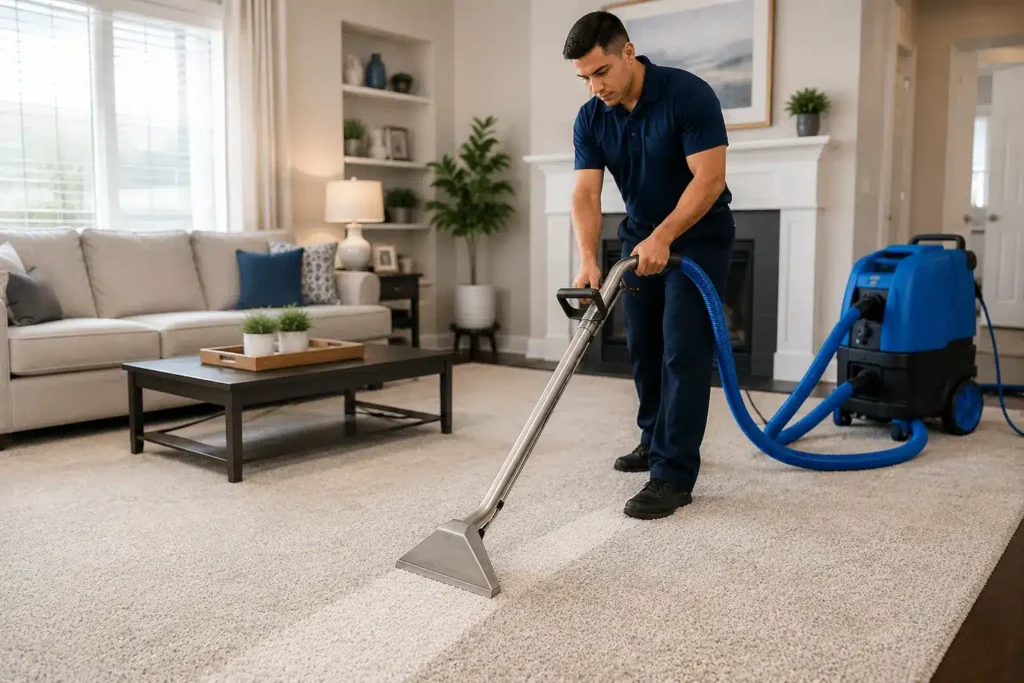
We are a carpet cleaning company in San Antonio, so take the obvious point first: we are not going to tell you we are the best one. That claim is worth nothing coming from us and you should distrust it coming from anyone else. What is worth something is a checklist you can run on any company in this city, us included, and which mostly has verifiable answers. Run it on our carpet cleaning service and on the two or three others you are considering, and let the answers decide.
The eight checks, in one line each
- The method suits your carpet and your carpet’s warranty.
- You get a written price with a definition of what a room is.
- They will send you an insurance certificate if you ask.
- Any training or certification they claim can be looked up.
- The reviews are real, recent and specific.
- The guarantee exists in writing and says what it actually covers.
- The phone number and business details match what is on their Google profile.
- They give clear answers on drying, furniture and pets rather than reassuring noises.
The eight-point checklist
1. The right method for your carpet
Hot water extraction and low-moisture encapsulation do different jobs. A company that recommends the same thing for every house without asking what the carpet is or how dirty it is has not looked at the problem.
2. A written price with a room definition
Not "from" a price. A number, what it covers, and what a room means in square feet. Get it before anyone is dispatched.
3. Insurance you can see
Ask for a general liability certificate naming the business. A company that carries it can usually send it the same day. One that changes the subject has told you something.
4. Training you can look up
Certification means something only if you can verify it. Ask for the certificate number, then check it yourself.
5. Reviews that read like real jobs
Dates spread over time, job detail, replies from the owner, photographs. Volume matters less than texture.
6. A guarantee with terms
What triggers it, what it covers, how long you have to raise a problem, and whether it is a re-clean or a refund.
7. A local presence that checks out
A phone number that reaches a person, details that match the Google profile, and a straight answer about where the business operates from.
8. Straight answers on the practical stuff
How long the job takes, what drying depends on, which furniture moves, what to do with pets. Vague answers here usually mean vague work later.
How to verify credentials in five minutes
Most claims in this trade can be checked faster than it takes to read the advertisement making them.
- Certification. The IICRC publishes a Global Locator for certified firms and technicians. Search the company name. If nothing comes up, ask for the certificate number and the name it was issued to, then search that. A certification held by one technician who left two years ago is not a certification held by the company.
- Cleaning products and equipment. The Carpet and Rug Institute tests cleaning solutions and machines and lists Seal of Approval service providers. It is a short list and being absent from it is not disqualifying, but being on it is checkable.
- “Licensed carpet cleaner” in Texas. Texas does not license carpet cleaning. The Texas Department of Licensing and Regulation licenses many trades, but there is no carpet cleaning program to be licensed under, so treat the word “licensed” on a carpet cleaning advertisement as marketing until someone shows you which license they mean.
- Duct work is different. Work on your air conditioning system beyond basic duct cleaning — sanitizing treatments, antimicrobial fogging, anything that alters the system — falls under TDLR’s air conditioning and refrigeration rules. If a carpet cleaner offers to treat your ducts, ask which license covers it. There is more on what duct cleaning is and is not in our air duct cleaning page.
- Mold is very different. In Texas, remediating mold covering 25 contiguous square feet or more requires a TDLR mold license; smaller areas are exempt under Occupations Code section 1958.102. A carpet cleaner who offers to “take care of” visible mold across a large area without mentioning licensing is the wrong contractor for that job.
Insurance: what to ask for
Three questions, and you want them answered before anyone is in your house with a machine.
- “Can you send me a certificate of general liability insurance naming your business?” The certificate is a one-page document the insurer issues; any insured contractor can forward it.
Reading reviews without getting fooled
Since 21 October 2024 the Federal Trade Commission’s rule on consumer reviews has made several common practices illegal: buying or writing fake reviews, generating them with AI, paying for a review on condition that it is positive, and undisclosed reviews written by the owner, their managers or their staff. That has not made every review honest. It has made the dishonest ones a legal risk, which is a start.
- Look at the spread of dates. Twenty reviews in one week, then silence, is a campaign. A trickle over three years is a business.
- Look for job detail: the room, the stain, the name of the technician, what went wrong and how it was handled. Detail is hard to fake at volume.
- Read the owner’s replies to the bad reviews, not the good ones. How a company answers a complaint in public is the closest you get to seeing how it will treat you when something goes wrong.
- Check more than one platform. A perfect record in one place and nothing anywhere else is worth a second look.
- Weigh the review count against how long the company says it has been trading.
Applied to us: we do not currently display a star rating or a review count anywhere on this site, and we are not going to until there are real reviews to show. When there are, they will be published on this site with their source visible.
Questions to ask on the phone
- Which method will you use on my carpet, and why that one?
- Does your method meet my carpet’s warranty? Mohawk, for example, requires professional hot water extraction every 18 months using CRI Seal of Approval products (Mohawk care and warranty guide).
- What is included in the price, and what is extra?
- What counts as a room, and what happens to a room over that size?
- What does drying depend on in my house, and what should I do to speed it up?
- What furniture do you move, and what do I need to move?
- What is your guarantee, and can I have it in writing?
Red flags
- Bait-and-switch pricing. A headline price that becomes a different number once the equipment is in your hallway. The mechanics of how those offers are built are in what a low price should include.
- Pressure to book now. Today-only pricing on a service that will exist tomorrow.
- “Certified” with no number. If they cannot say certified in what, by whom, and under what number, it is a word rather than a credential.
- Health promises. Anyone telling you a carpet clean will fix allergies, kill everything in your house or sanitize your home is making a claim they cannot support. Cleaning removes soil. That is the claim we make and it is the one we can stand behind.
- Full payment up front, in cash. The FTC’s advice on hiring for home work is to get the estimate in writing and not to pay the full amount before the job is done (FTC, How to avoid a home improvement scam).
- A secret branded method they cannot explain. Every legitimate process is describable in plain words. If the explanation is a trademark, ask what physically happens to the carpet.
- Dodging the insurance question. Covered in full above, and worth repeating: the certificate either exists or it does not.
Hot water extraction or low-moisture?
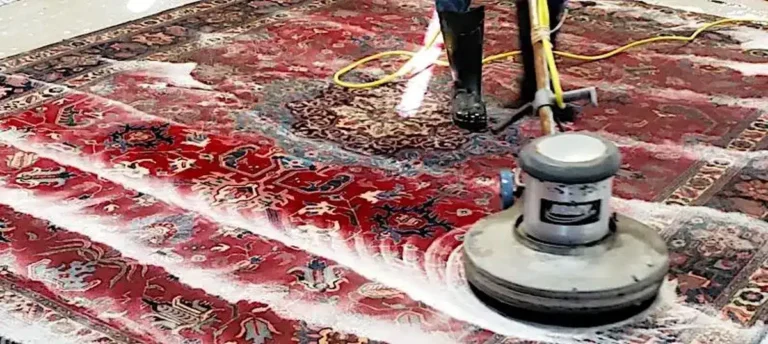
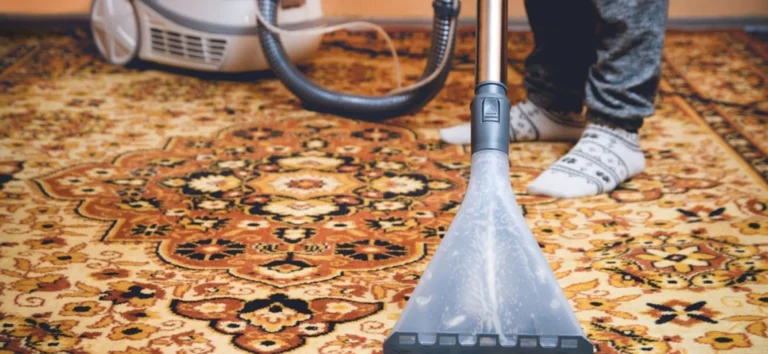
Hot water extraction puts a cleaning solution into the pile, agitates it, then flushes and extracts it under vacuum. It is the deeper clean, it uses more water, and it is what most carpet warranties are written around. It is the right choice for carpet that is genuinely soiled, for pet problems, and for the periodic deep clean.
Low-moisture encapsulation applies a polymer that crystallizes around the soil so it can be vacuumed away, using far less water. It suits interim maintenance, traffic lanes between deep cleans, and places that cannot be out of use for long. It does not replace a warranty-required hot water extraction. More on the trade-off in how the methods work and on low-moisture encapsulation.
How we answer this checklist
Same eight checks, our answers, with links to the proof.
| Check | Our answer | Proof |
|---|---|---|
| Method suits the carpet | Hot water extraction and low-moisture encapsulation; which one is decided by the carpet and the job, not by what is on the van | How the methods work |
| Real, recent reviews | None displayed. We will not show a rating until there are real reviews behind it | Not published yet |
| Local presence that checks out | We are mobile and work across San Antonio and the surrounding areas; there is no shopfront for customers to visit. The number is (726) 210-8405 | Contact us |
Choosing a carpet cleaner: questions
How do I choose a carpet cleaning company?
Run the eight checks: the method suits your carpet, the price is written down with a room definition, they will send an insurance certificate, any training claim can be looked up, the reviews read like real jobs, the guarantee exists in writing, the business details check out, and the practical answers are specific.
Do carpet cleaners need a license in Texas?
There is no state license for carpet cleaning itself. Duct work beyond basic cleaning falls under TDLR’s air conditioning rules, and remediating mold across 25 contiguous square feet or more needs a TDLR mold license. Ask which license someone means before you accept the word.
How can I check if a company is IICRC certified?
Search the IICRC Global Locator, or ask for the certificate number and the name it was issued to and check that. Certification belongs to a person or a firm, not to an advertisement.
Are cheap carpet cleaners worth it?
Sometimes. A low price is a problem only when it hides something: a room size cap, add-ons that turn out to be compulsory, or a job rushed to fit the money. Check what the price includes before you judge it.
How often should carpets be professionally cleaned?
The Carpet and Rug Institute recommends every 12 to 18 months. Some carpet warranties are stricter and require professional hot water extraction on a set interval.
Should I ask for proof of insurance?
Yes. Ask for a general liability certificate naming the business, and ask separately whether technicians are covered by workers’ compensation, which most private employers in Texas are allowed to opt out of.
Run the checklist on us
Our prices are published, our guarantee is written down, and what is not confirmed yet is marked as not confirmed. Ask us for the rest.