If you are a pet owner in San Antonio, you already know the routine. One moment your living room looks perfect, the next your dog has tracked mud across the carpet or your cat has left a surprise in the corner. Reaching for a homemade cleaner feels like the responsible choice as natural, affordable, and right there in your kitchen. But not every DIY solution is as safe or effective as the internet claims. Some can actually make the problem worse.
At San Antonio Carpet Cleaning, we have spent years helping families deal with pet-related carpet issues across Central, North, South, East, and West San Antonio. We have seen what works, what fails, and what causes damage that could have been avoided. This guide breaks down the most common homemade carpet cleaning solutions pet owners use, explains the science behind each one, and tells you honestly when it is time to call a professional.
Why Pet Stains Are Different from Ordinary Spills
Pet accidents are not like knocking over a glass of juice. Urine, vomit, and feces contain proteins, fats, bacteria, and uric acid salts that bond aggressively with carpet fibers. When urine dries, bacteria break down the urea into ammonia, which is why old pet stains smell so strongly. As decomposition continues, thiols are released, making the odor even more potent and difficult to remove.
The real problem is uric acid. Unlike urea and other water-soluble components, uric acid is not water soluble and bonds tightly to whatever surface it touches. Due to the uric acid component, cat and dog urine has a half-life of about six years. This means that without proper treatment, the odor can return whenever humidity rises, because uric acid salts re-form and release smell again, often at levels undetectable to humans but clearly noticeable to pets, which encourages repeat marking in the same spot.
This is why understanding what your homemade cleaner actually does at a molecular level matters so much.
The Most Common Homemade Solutions: A Breakdown

-
White Vinegar and Water
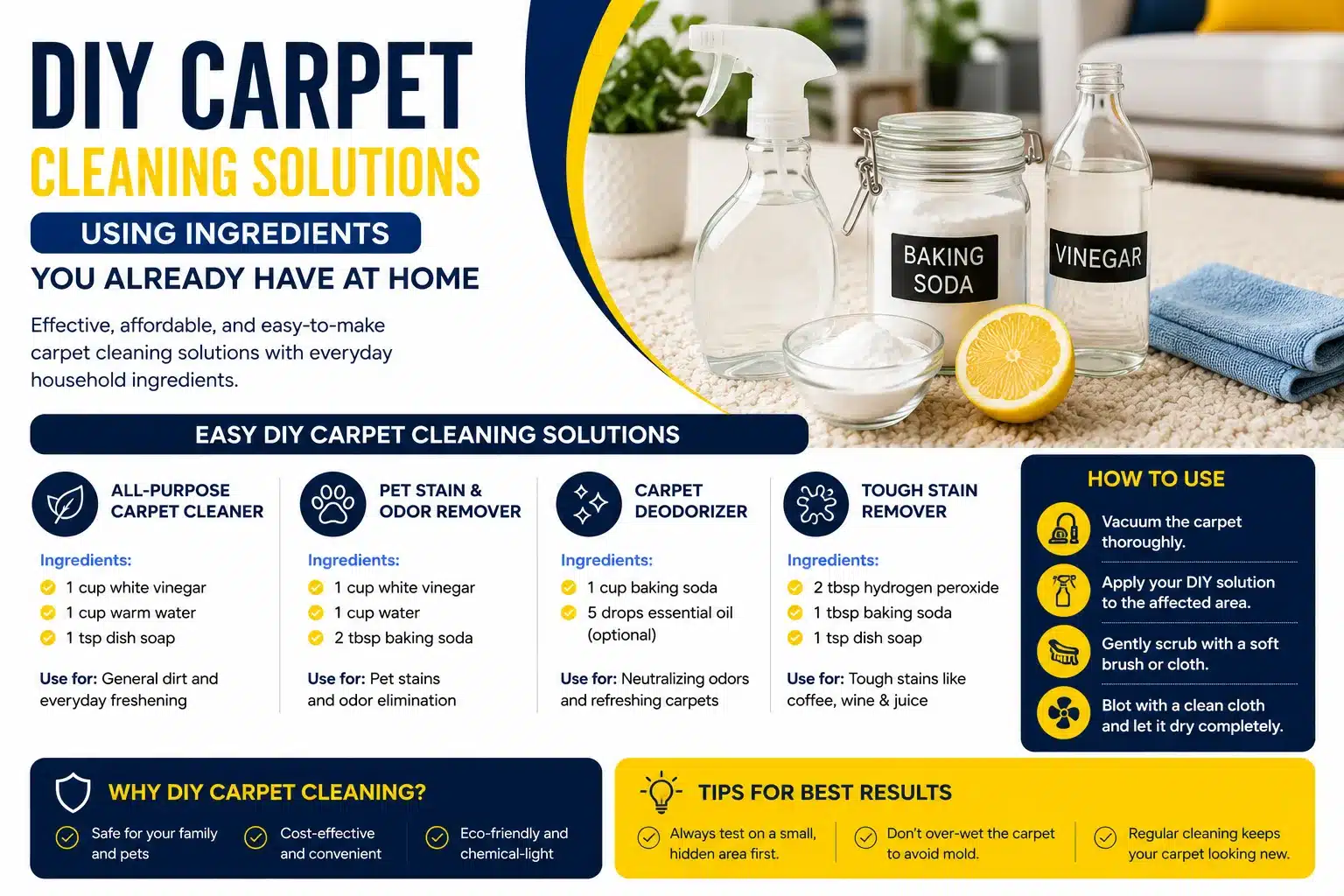
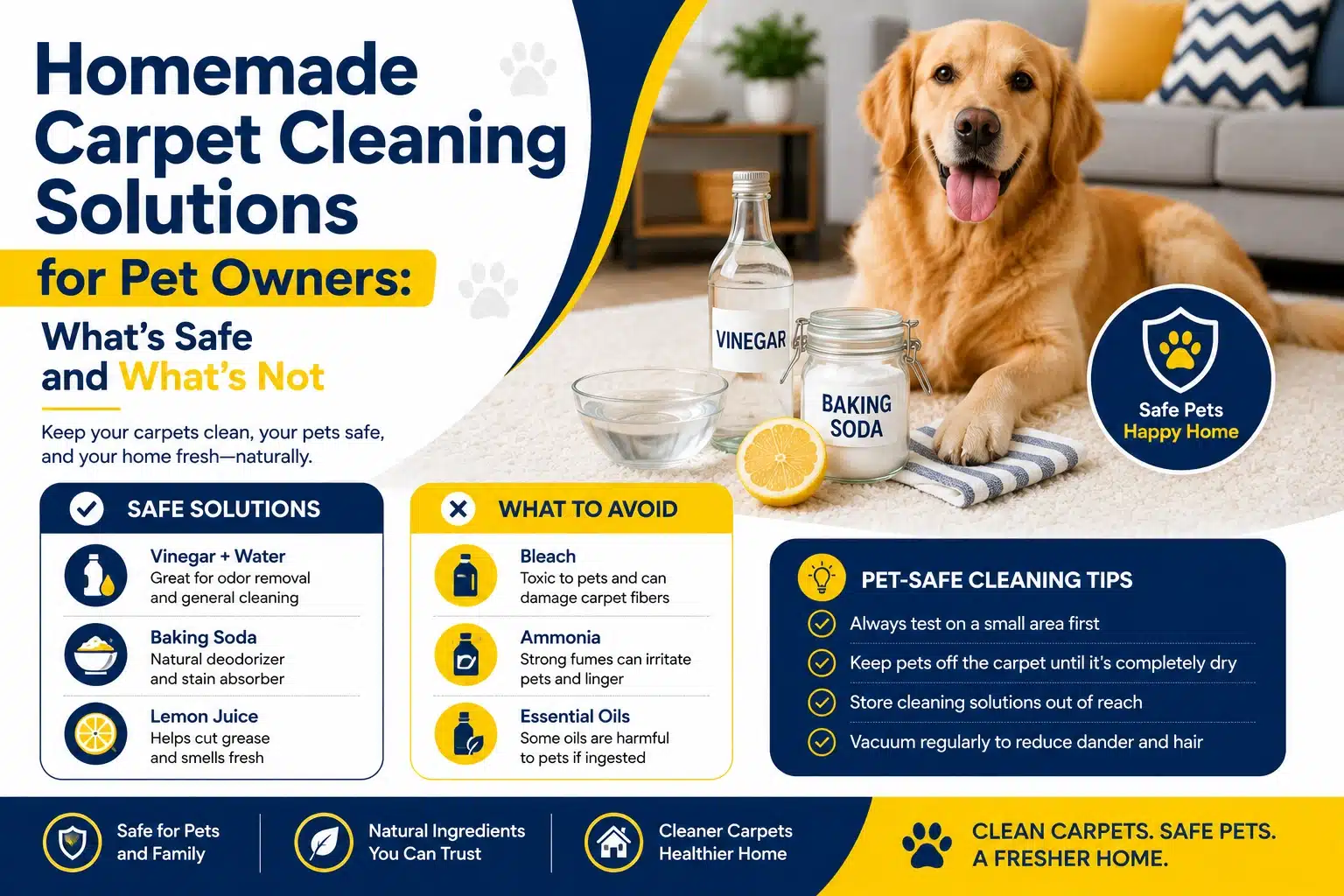
Vinegar is probably the most recommended DIY carpet cleaner online, and for basic deodorizing, it has real merit. White vinegar is acetic acid, which helps dissolve dirt, break down mineral deposits, cut through grease, and neutralize some odors. For general freshening of lightly soiled carpets, a mix of one-part white vinegar to one or two parts water can help.
The limitation: Vinegar does not break down uric acid. It may neutralize the ammonia smell temporarily, but it cannot destroy the uric acid salts that cause long-term odor recurrence. In some cases, the acidity can actually set protein-based stains deeper into carpet fibers, making professional removal harder later. Vinegar is also not effective against the bacteria in pet waste that contribute to ongoing odor and potential health concerns.
Verdict: Safe for surface deodorizing and light cleaning, but not a solution for actual pet urine stains or odor elimination.
-
Baking Soda
Baking soda, or sodium bicarbonate, is an excellent natural deodorizer. It absorbs odors and can be used as a dry treatment by sprinkling it over carpet, letting it sit for several hours or overnight, and vacuuming thoroughly. For pet odors, allowing more dwell time before vacuuming improves results.
The limitation: Baking soda only masks odors temporarily. It does not eliminate them at the source. It does not break down uric acid, proteins, or bacteria. It is purely an absorbent, not a cleaner. If you sprinkle baking soda over a wet pet stain, you may create a paste that is difficult to fully vacuum out, potentially leaving residue in carpet fibers.
Verdict: Useful as a maintenance deodorizer between deep cleanings, but ineffective as a stain or odor remover for pet accidents.
-
The Vinegar and Baking Soda Combination
When you combine vinegar and baking soda, you get a satisfying fizzing reaction. The carbon dioxide bubbles can help lift some surface dirt and loosen debris. This combination is often promoted as a deep-cleaning miracle.
The limitation: The chemical reaction between vinegar (acid) and baking soda (base) essentially neutralizes both substances, producing water, carbon dioxide, and sodium acetate. Once the fizzing stops, you are mostly left with salty water. The reaction does not produce any cleaning agents capable of breaking down uric acid or digesting organic matter. The fizzing may give the impression of deep cleaning, but the actual chemical action is minimal for pet stain removal.
Verdict: Satisfying to watch, but largely ineffective for real pet stain and odor problems.
-
Hydrogen Peroxide (3% Solution)
Hydrogen peroxide is an oxidizer that can lift tough organic stains like coffee, wine, and some pet messes through oxidation. It is also an approved disinfectant ingredient, though its effectiveness varies by surface and concentration.
The serious concern for pet owners: Hydrogen peroxide is not safe for pets if ingested or if they walk on treated surfaces and lick their paws. Ingestion can cause severe stomach inflammation, ulcers, and breathing complications in cats and dogs. Even topical exposure to skin or paws may result in irritation and rashes. Higher concentrations can cause internal burns. While a 3% solution is commonly found in homes, its use on carpets where pets walk, lie, and potentially lick residue is risky.
Additionally, hydrogen peroxide can lighten or bleach carpet fibers, especially on darker carpets. It does not break down uric acid effectively.
Verdict: Potentially effective for stain lifting on colorfast, light-colored carpets, but carries real safety risks for pets and should be used with extreme caution or avoided in pet households.
-
Dish Soap and Water
Dish soap is a surfactant, meaning it helps water penetrate fibers and lift dirt and oils. A small amount, about one teaspoon per gallon of water can help with general spot cleaning.
The limitation: Dish soap is designed to be rinsed off dishes under running water. Carpets do not rinse the same way. Excess dish soap leaves a sticky residue that attracts dirt and grime over time, making your carpet look dirty again faster. In pet households, this residue can also irritate sensitive paws. Excess moisture from soapy solutions can lead to mold growth, especially in San Antonio’s humid climate.
Verdict: Okay for occasional spot cleaning if used sparingly and rinsed well, but not ideal for regular use or deep pet stain treatment.
-
Essential Oils
Some pet owners add essential oils like tea tree, lavender, or eucalyptus to homemade cleaners for fragrance and perceived antibacterial properties.
The serious concern: Many essential oils are toxic to pets, especially cats. Tea tree oil, peppermint, citrus oils, and others can cause vomiting, diarrhea, drooling, tremors, and even liver damage if ingested or absorbed through the skin. Pets are exposed through licking treated surfaces, walking on damp carpets and then grooming, or inhaling concentrated vapors.
Verdict: Avoid adding essential oils to carpet cleaners in pet households. The risks far outweigh any benefits.
What Actually Works: Enzymatic Cleaners
If homemade solutions have a common weakness, it is that none of them can break down uric acid. The only cleaners capable of doing this are enzymatic or bioenzymatic formulas.
Enzymatic cleaners contain specific enzymes that digest the proteins, uric acid, and organic matter in pet waste at a molecular level. The enzymes break down uric acid into carbon dioxide and ammonia, both gases that then easily evaporate as the area dries. This is why proper dwell time, usually 10 to 15 minutes, sometimes longer for set-in stains, is essential. The cleaner needs time to work.
Quality enzymatic cleaners are biodegradable, non-toxic, low in volatile organic compounds, and safe for pets and children when used as directed. They do not mask odors; they eliminate the source, which also removes the scent cues that encourage pets to re-mark the same spot.
For homes with multiple pets or recurring accidents, enzymatic cleaners are the gold standard. They are the only type of cleaner that can truly solve the uric acid problem.
What Professional Pet Stain Treatment Looks Like
When San Antonio Carpet Cleaning handles pet-related carpet issues, our process goes far beyond surface treatment:
- Inspection and detection: We use UV light to locate all urine spots, including old ones that may not be visible to the naked eye. This ensures we treat the full problem, not just the spots you can see.
- Deep extraction: We flush urine residue out of the carpet fibers with hot water extraction and pull it back out with powerful suction. Removing as much moisture as possible helps the carpet dry faster and lowers the risk of mold growth.
- Targeted enzymatic treatment: For severe pet stains, we apply professional-grade enzymatic solutions that saturate the affected area down to the padding. We allow proper dwell time for the enzymes to fully break down uric acid and organic matter.
- Odor neutralization: Rather than masking smells, our treatments eliminate odor at the molecular level. This includes treating the backing and padding, not just the carpet surface.
- Post-cleaning verification: We inspect the treated areas after cleaning to ensure stains and odors have been properly addressed. Our satisfaction guarantee means if you are not happy, we will make it right.
- Eco-friendly products: All our cleaning solutions are green-certified, non-toxic, and safe for children and pets. No harsh chemicals, no toxic residues, no worries.
Conclusion
Homemade carpet cleaning solutions are not inherently bad. Vinegar, baking soda, and mild dish soap have their uses for light cleaning and maintenance. But pet stains are a different category of problem. The chemistry of pet urine, specifically the uric acid component makes it resistant to almost every common household cleaner. Using the wrong solution does not just waste your time; it can set stains deeper, leave residues that attract more dirt, create safety risks for your pets, and allow odors to return again and again.
The best approach is honest: use homemade solutions for what they can actually do, and recognize when a problem requires professional-grade treatment. Your carpet is an investment in your home. Your pets are family. Both deserve care that actually works.
At San Antonio Carpet Cleaning, we understand the frustration of pet stains because we are pet owners too. We also understand the science of carpet fibers, stain chemistry, and the specific challenges of San Antonio’s climate. Our family-owned business has built its reputation on honest, reliable service, treating every customer like family, showing up on time, and delivering results that last.